




When your baby comes into this world, they cry. Understanding the types of baby cries is very important for new parents because each cry has a different meaning. Babies use crying as their main way of communication before they learn to talk, and each sound tells you something specific about their needs.
You might have noticed that your baby doesn’t cry the same way all the time, just as we don’t always say the same words. The babies’ cries change depending on what they are trying to convey.
Knowing why your baby is crying can be difficult, especially for new parents. This is exactly why I have written this guide. As a mom of three, I can share the feeling of guilt and frustration when you can’t figure out why your baby is crying for the last 20 minutes.
This article includes everything I have learned from my experience (and other parents’) about different newborn cries. It breaks down each of the baby cries’ meaning and sound.
What Are the 5 Types of Baby Cries and What They Mean?
The 5 most common baby cries are the hungry cry, the tired cry, the pain cry, the discomfort cry, and the bored or lonely cry.
An Australian opera singer, Priscilla Dunstan, spent years recording and analyzing infant sounds. She noted that newborns make specific pre-cry sounds based on physical reflex, before full crying even starts. It is usually called ‘Dunstan Baby Language.’
Every baby is different, and they express their feelings and emotions differently. Learning your own baby’s cues and patterns truly helps you tend to them.
It doesn’t happen overnight. But with attention and repetition, those cries start to make sense.
The Hungry Cry ~ “Neh, Neh”
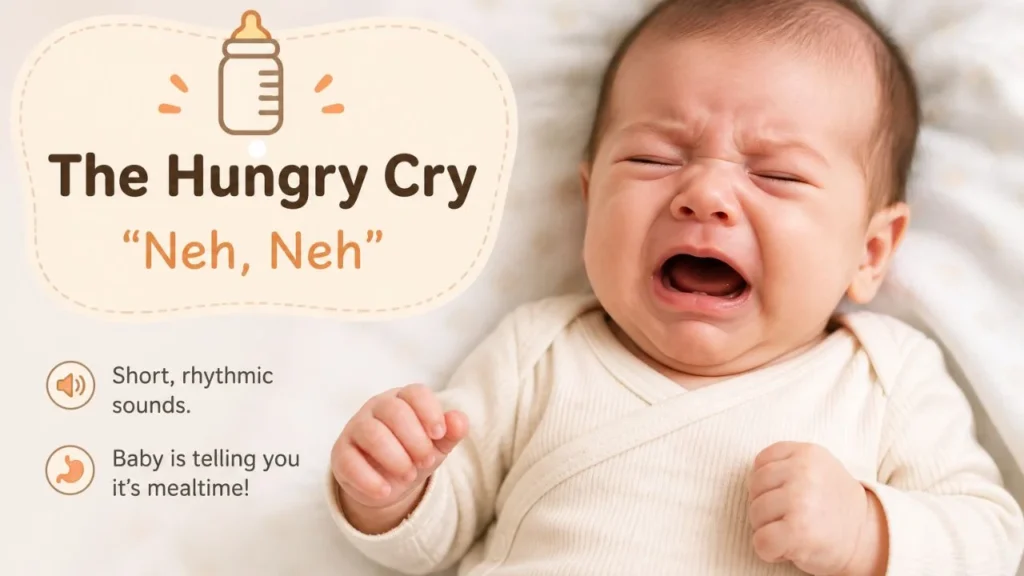
This is the one you’ll deal with most, especially in the first few months. It’s repetitive, rhythmic, and it gets loud fast.
Priscilla Dunstan’s research identifies this as a “neh” sound. The tongue pushes against the roof of the mouth as the sucking reflex kicks in. It usually starts relatively low and ramps up the longer it goes unanswered. It’s not subtle once you’ve heard it a few times.
What To Do?
Feed them. If your baby settles quickly, that’s it. Sometimes\ they aren’t full even after meals, it’s ok
If you’re in the toddler stage and noticing constant hunger cues even after full meals, it’s worth understanding toddler overeating symptoms to know what’s actually normal at that age.
The Tired Cry ~ “Owh, Owh”

It’s softer than the hunger cry. Breathy. A little whiny. I used to miss it often just because of how slow and drawn-out it is.
The “owh” sound comes from the yawn reflex. The jaw drops open slightly as the body signals fatigue. Watch for the physical cues alongside it:
- Eye-rubbing
- Staring blankly at nothing
- Turning their face away from things they’d normally track.
Those three together are a pretty reliable signal.
What To Do?
Dim the lights, lower the noise, and start winding down. A consistent bedtime routine trains your baby’s body clock so the tired cry starts showing up at roughly the same time each night.
Quick Tip: If your child is past the newborn stage and sleep is still a real battle, consider sleep training.
The Pain Cry ~ Sudden, High-Pitched Shriek

You’ll know this one immediately. It doesn’t build, it just starts. Sudden, high-pitched, and urgent in a way that’s hard to describe until you’ve heard it. Some parents say it sounds almost panicked. That’s because physiologically, it is. Our nervous system’s response to pain is usually fast and sharp.
There’s often a brief silence right after the first shriek, then it picks back up. That pause-and-resume pattern indicates that your baby is in pain.
What To Do?
Check quickly and systematically. Look at fingers and toes first. Check the diaper area for rashes. If the crying is inconsolable, comes with a fever, or just feels different from anything you’ve heard before, call your pediatrician.
The Discomfort Cry ~ “Eairh, Eairh”

Discomfort cry is lower and more strained than a hunger cry. The baby often looks uncomfortable rather than distressed.
Some other signs are:
- Scrunching their face
- Pulling their knees toward their belly
- Going stiff, then relaxing in cycles.
Gas is the usual culprit, so is a wet diaper that’s irritating the skin. The “eairh” sound has a pushed quality to it, almost like the baby is bearing down.
What To Do?
Diaper check first. If that’s clean, try bicycling the legs or a gentle clockwise tummy massage to help move the gas along.
Pro Tip: Keep your baby upright for 10-20 minutes after feeding. It reduces gas buildup and hence, discomfort cries.
The Bored or Lonely Cry ~ “Eh, Eh, Eh”
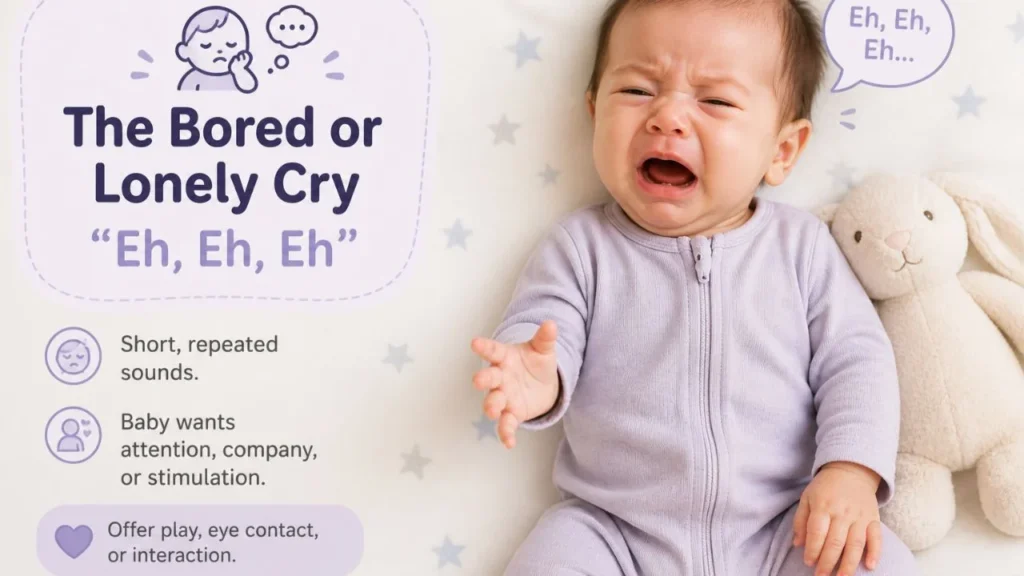
What Does “Eh, Eh, Eh” Mean in Baby? It means your baby is getting bored.
This one starts as a coo or a grunt and only turns into actual crying if nobody shows up. Pick them up, make eye contact, say something, and it stops.
This isn’t a baby being dramatic. It’s about them needing to connect with you. Responding to this cry isn’t creating a bad habit. It’s creating a genuine connection, so that your baby can always reach out to you.
What To Do?
Pick them up, change their scenery, get on their level, and talk to them. It usually doesn’t take long.
Baby Cry chart
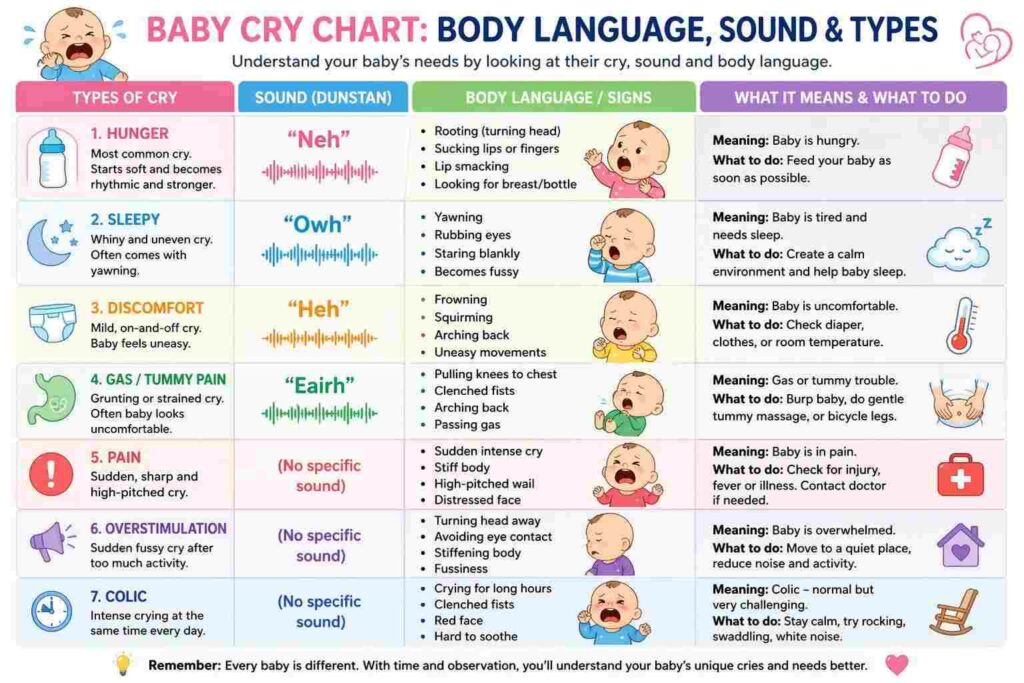
You’re Going to Get This Wrong Sometimes, and That’s Okay
Misreading a cry doesn’t mean you’re doing it wrong. It means your baby is a person with their own specific version of these sounds, and you’re still learning them.
Most parents start picking up their baby’s individual patterns somewhere around weeks four to six.
Parenting is challenging on its own. You don’t need to bring guilt into the mix. Be patient, give yourself time, and just observe for the first few weeks. You’ll figure it out.
When to See a Doctor
Call your pediatrician if your baby’s cry:
- Is high-pitched and won’t stop or calm down
- Sounds noticeably different from their usual cry
- Has no obvious cause and goes on for several hours
- Comes alongside fever, vomiting, or unusual stiffness
You know your baby better than any checklist does. If something feels off, that instinct is worth a call.
The Bottom Line
Most parents start recognizing their baby’s cry patterns within the first month, usually without even trying to. It happens through repetition — same cue, same response, same result. You start connecting the dots without realizing you’re doing it.
If you want to speed that up, start with the five types here: hungry, tired, pain, discomfort, lonely.
Watch the body language alongside the sound. Let the timing and context fill in the gaps. You won’t get it right every time, and that’s fine. Showing up, paying attention, and adjusting as you go is what being a better parent actually looks like.